Jev: The Decision Model That Puts AI Inside Software
Jev returns typed decisions and probabilities instead of prose. This article examines its architecture, use cases, performance claims, and realistic role beside LLMs.

Jev: The Decision Model That Puts AI Inside Software
Jev is a new AI model released in early access by TypeSafe AI on September 15, 2026. The right way to understand it is not to place it in the same race as ChatGPT, Claude, or another chat model. Jev does not generate prose. It receives application state, questions, and possible answers, then returns typed decisions with probability distributions.
That distinction addresses a common production problem. When we ask an LLM, “Should this support ticket go to the technical team?” and expect JSON, the model first generates text. The application then parses and validates that text before it can enter a workflow. Formatting errors, unexpected fields, and unreliable statements such as “I am 92% confident” can appear in between. Jev's proposition is to remove that text layer and provide a decision that software can consume directly.
After reading TypeSafe's launch post, the LangChain integration, independent analyses, and early community experiments, a clearer picture emerges. Jev is not a replacement for general-purpose LLMs. It is better understood as a layer before or after an LLM, designed for frequent semantic decisions inside software.
What does Jev actually do?
TypeSafe calls this approach a System One model. The name refers to Daniel Kahneman's distinction between fast, intuitive System 1 thinking and slower, deliberate System 2 reasoning. In software terms, the idea is to produce a judgment in a few hundred milliseconds instead of asking a conversational model to write an explanation for every branch in an application.
The basic flow is simple:
state + questions + allowed answers
                ↓
              Jev
                ↓
typed answers + probabilities + confidence
                ↓
           application code
The state can be a customer message, a payment record, a JSON object, a game state, or the result produced by an agent. Questions are small decisions the model should make about that state. The shape of the answer is defined in advance, while the developer defines the meaning of the criteria.
The Noul primitive estimates the probability that a statement is true. Choice selects from a list and returns probabilities for the options. Score rates the state against an ordered scale such as low, medium, and high.
These question types can be mixed in one request. A support application could ask which department should handle a ticket, whether it is urgent, and how frustrated the customer sounds. Jev evaluates the questions in parallel and in isolation, according to the public documentation.
A fintech example: where does Jev fit in fraud decisions?
Consider a transaction described by amount, currency, sender and recipient country, channel, device information, account age, and previous transaction patterns. We could ask Jev, “Is this transaction fraudulent?” But there is an important engineering distinction.
If you have thousands of labeled transactions and strong features, XGBoost, logistic regression, or a dedicated neural model may remain the better and cheaper production choice. Jev is not an automatic replacement for a supervised tabular fraud model. When numeric patterns, time series, and company-specific historical data drive the decision, throwing away a trained model makes little sense.
Jev may add value in the semantic layer where rules and labels are limited. Is the payment description consistent with a social-engineering pattern? Does the transaction context warrant manual review? Does the customer message contain a request to bypass a verification step? These can be separate questions, and application code can combine them:
risk_questions = {
    "suspicious_context": ...,   # Noul
    "review_required": ...,      # Noul
    "risk_band": ...             # Score
}

# The model does not move money by itself.
# Thresholds, limits, and human review stay in code.
This design is easier to audit. Jev can estimate that a transaction belongs to a high-risk category, while the application decides whether to block it, ask for another verification step, or send it to an analyst. The model supplies evidence for a policy. It does not replace the policy.
Direct probabilities instead of generated confidence
An LLM saying “this ticket should go to technical support, with 85% confidence” is not the same as Jev assigning 0.85 probability to the technical option. In the first case, the number is part of a generated string. In the second, the number is part of a decision distribution returned by the API.
This difference is at the center of Jev's speed argument. A conventional LLM generates a response token by token. It writes the option name, JSON keys, punctuation, and perhaps an explanation in sequence. Even with structured output, the system is constraining a text-generation process inside a schema.
Jev's public interface defines the options before inference. The model does not need to write a sentence about the choice. Its representation can be read into probabilities for the allowed answers, and the application can serialize the result into JSON. Multiple questions can therefore be evaluated in one request.
Archer Hume's independent architecture analysis develops this idea further. Based on observed API behavior, the author proposes that Jev may encode shared state once and evaluate each question in a separate branch, followed by a direct numerical readout. The latency and visibility experiments are interesting, but the author is also explicit that this is a reconstruction from a black-box API.
We should separate what is published from what is inferred. TypeSafe describes parallel outputs, typed questions, and Reinforcement Learning for Calibrated Decisions, or RLCD. It does not publish the complete layer architecture, parameter count, or proof that Jev uses a sparse Mixture of Experts design. Claims about the exact internals remain premature.
How accurate is the claim that Jev cannot hallucinate?
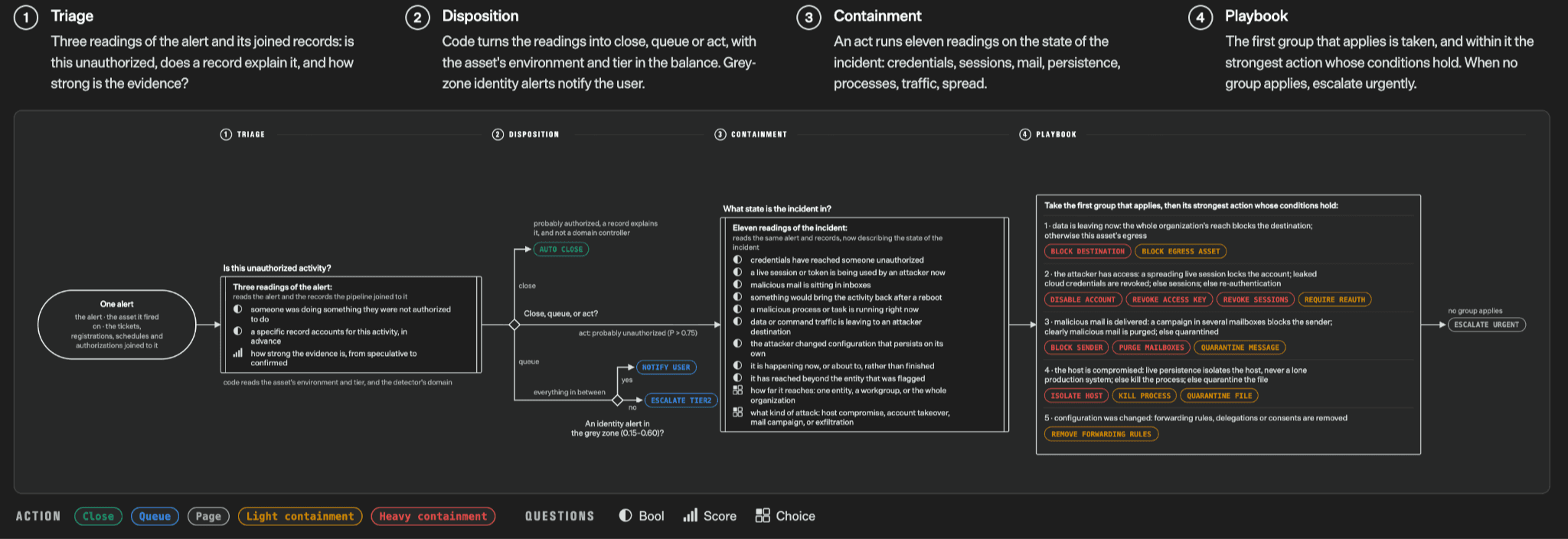
TypeSafe's claim is technically correct in a narrow sense. Jev cannot leave the declared types or invent a new option. If the application provides “billing”, “technical”, and “sales”, the model cannot return a fourth department as an unexpected JSON key. It cannot invent a tool name or produce malformed arguments outside the declared result shape.
That does not mean Jev always makes the right semantic judgment. It can choose an allowed option and still be wrong. It can classify a safe transaction as risky, a technical ticket as sales, or a legitimate request as suspicious. The Register makes the same distinction: the model is not intended to fabricate sources or prose, but structured output does not prevent an incorrect judgment.
The more useful promise is therefore calibration, not “zero hallucinations.” If the model assigns 0.90 probability to similar cases, roughly 90 percent of those cases should be correct. That relationship must be measured on your own data before a confidence value becomes an automatic permission to act. Calibration can change across domains, languages, data quality, and question wording.
A practical policy looks like this: automate clear cases when the cost of a mistake is low, request more information in the middle range, and escalate uncertain cases to a person. As the cost of a wrong decision rises, the threshold should rise as well. Jev should not be the final authority for payment, credit, health, or security decisions without an independent control layer.
Speed and cost: impressive numbers that need proper context
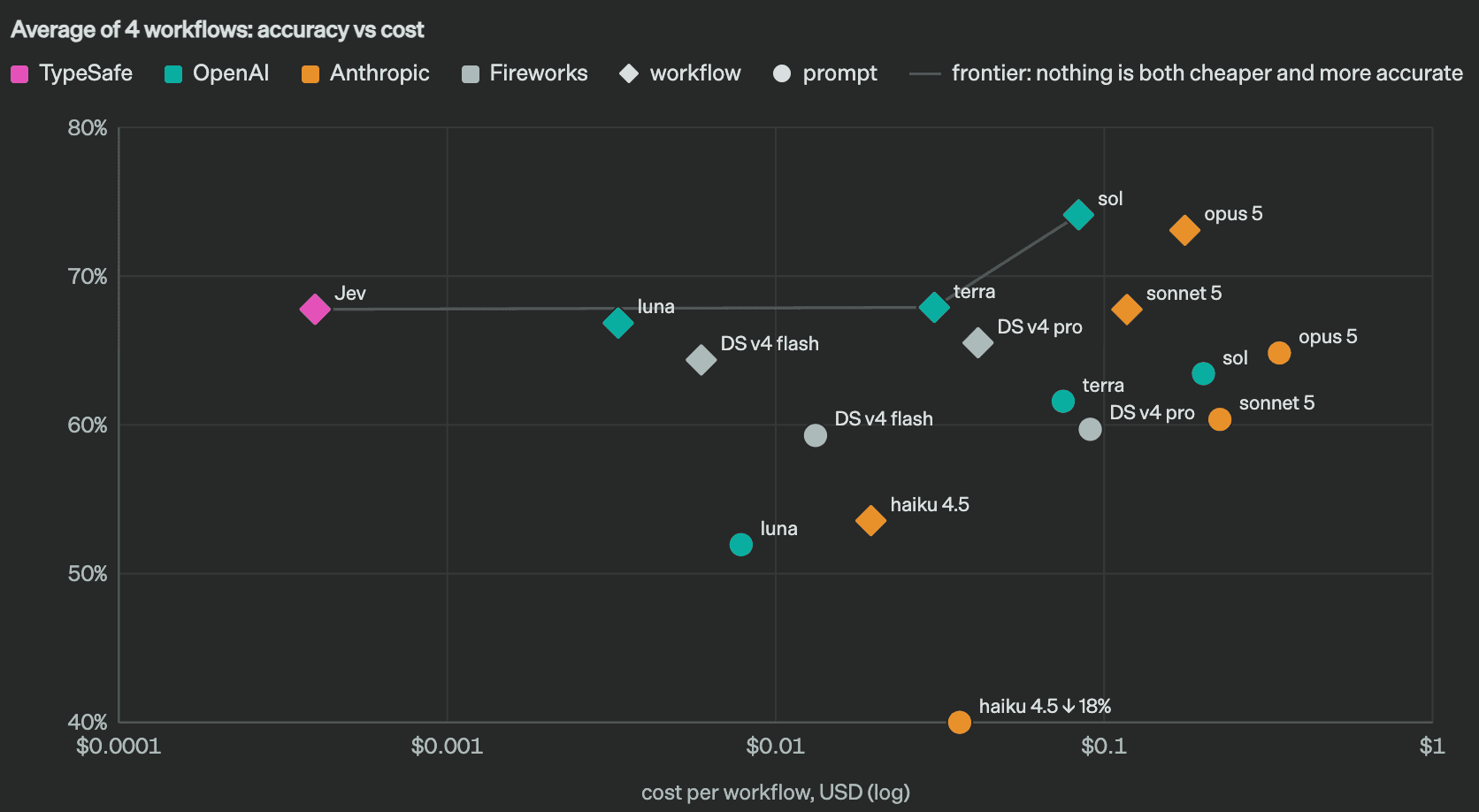
TypeSafe lists a price of $0.042 per million input tokens and no charge for output tokens. In its own workflow evaluations, the company reports end-to-end response times from 70 to 500 milliseconds and up to 193.6 times the speed and 444.6 times the cost efficiency of selected LLM baselines.
The comparison details matter. TypeSafe says it uses average predictions from GPT-6 Astra and Fable 5.1 as references, and it wraps the LLM baselines with its System One adapter so that they return compatible structured decisions and probabilities. This is an attempt to compare the systems on the same workflow, but it is still primarily a vendor-produced evaluation.
Small independent tests provide a more balanced view. Mike Taylor at Every ran 21 questions over 37 documents and received 777 judgments in less than 0.7 seconds, at an estimated cost below a quarter of a cent. In another test, Jev caught six of seven deliberately introduced defects in 12 passages, while Fable 5.1 caught all seven. Jev's median time was 0.35 seconds, compared with 8.83 seconds for Fable at high effort.
The correct conclusion is not that Jev is better at every task. It is that a non-generative model can have a major economic advantage when the same fuzzy check must be performed hundreds or thousands of times. Production tests still need p95 latency, load behavior, data-transfer time, failure rates, human-review cost, and the impact of incorrect decisions.
What can developers build with Jev?
1. Support-ticket routing
A Choice question can route a request to billing, technical support, or sales. The same request can also be scored for urgency, frustration, and customer-loss risk. A conversational LLM can write the final reply, while Jev handles the fast routing decisions. This separates semantic classification from natural-language generation.
2. Agent safety gates
Before an agent executes a tool call, it can ask whether the command is irreversible, touches production data, or requires explicit user consent. LangChain's Jev article presents model routing and Auto Mode middleware for blocking risky tool calls. This is a natural fit because the agent already has a state and a set of possible next actions.
3. Retrieval, ranking, and context selection
An agent can use Jev to decide which documents deserve context, which tool should run next, or which search results should move to the top. LangChain's recommendation is not to remove the capable LLM. It is to use Jev as a fast filter and router, then call the larger model for planning, explanation, and open-ended generation.
4. Real-time environments
In TypeSafe's Doom demonstration, the model is not reading raw game pixels. It receives structured state and text, then chooses among possible actions. That does not make the demo uninteresting, but it tells us what it demonstrates: low-latency action selection from structured state. A similar intermediate layer could be useful for browser agents, simulations, or robotics. Critical physical control loops should remain in deterministic code or dedicated control models.
Jev compared with LLMs, classical ML, and encoder classifiers
It helps to separate four approaches.
- General-purpose LLM: Strong at explanations, code, plans, summaries, and open-ended generation. It generates text for decisions and needs schemas, parsing, and validation when software consumes the result.
- Jev: Designed for fast, typed, probabilistic decisions over declared options, scores, and propositions. It cannot write a story, produce arbitrary JSON, or explain a plan in natural language.
- Supervised machine-learning model: Often the better production choice when you have labeled data and stable features for fraud, churn, credit risk, or forecasting. Jev may be useful for zero-shot semantic criteria and rapid changes that do not justify retraining.
- Encoder and zero-shot classifiers: A mature family for direct text classification. Projects such as GLiClass show that an open model can score text against candidate labels without generating a paragraph. Jev's potential difference is a product-level interface that combines broad model knowledge, parallel fan-out, typed primitives, and a calibration objective.
This does not mean Jev has no new contribution. It may be packaging several ideas into one developer interface: natural-language criteria, option-independent questions, parallel evaluation, and probabilities that code can branch on. How well that combination works will be determined by independent benchmarks and real customer data.

The larger idea: a decision layer before the LLM
Jev's most interesting contribution is not a new chat experience. It is the separation of small semantic decisions that LLMs currently make inside larger workflows. Which tool should an agent use? Should it ask for confirmation? Should it retry? Which model should it call? Which document belongs in context? Each question may be as small as an if statement, but it is difficult to write with hard-coded rules because it depends on meaning.
Today many teams use a large LLM for these decisions. The model writes a paragraph, the application parses JSON, handles an exception, and continues to the next step. A Jev-like model could take over these repeated micro-decisions. The larger model would then be reserved for planning, explanation, and open-ended generation.
A hybrid architecture could look like this:
user request
     ↓
Jev: intent, risk, model, and tool selection
     ↓
LLM: planning or generation
     ↓
Jev: output and tool-call verification
     ↓
code: policies, thresholds, and side effects
This is a forecast, not a conclusion. Jev is still in early access, and a substantial part of its strongest performance evidence comes from TypeSafe's own tests. Pricing at sustained production volume, calibration in different languages, long-context behavior, and the real cost of wrong decisions are still open questions.
What should teams measure before production?
A Jev demo can look fast immediately. A production decision requires a more disciplined evaluation.
- Build a labeled test set from the real workflow. Do not rely only on the vendor's examples.
- Decompose broad judgments into atomic questions. Ask separately about urgency, department, risk, and permission instead of asking the model to “evaluate the ticket.”
- Measure probability calibration. Check how often cases assigned 0.80 probability are actually correct.
- Put uncertainty policy in code. Define the threshold for automation, the middle range for clarification, and the point for human review.
- Compare Jev with an LLM and a classical model on the same data. Measure p95 latency, error cost, and maintenance burden, not only average speed.
- Separate false positives from false negatives. A single accuracy number is not enough for payment and security workflows.
The community-maintained Awesome TypeSafe list collects official documentation alongside browser agents, games, robotics experiments, and independent benchmarks. It is useful for finding ideas, but individual community results should not be treated as production evidence without reproducing their methods.
Conclusion: AI does not always need to be a chatbot
Jev does not show that chat models are finished, or that every application should switch to Jev. It proposes a narrower and more practical interface: turn the semantic questions software asks repeatedly into direct probabilistic decisions instead of generated text.
TypeSafe's “cannot hallucinate” statement should be read as a guarantee about type and format, not semantic truth. Jev can still be wrong. But when options, probabilities, and uncertainty thresholds live in the application architecture, the system becomes easier to test and govern.
My expectation is that Jev-like models will increasingly appear as a layer around LLMs. They can handle classification, routing, ranking, policy checks, and agent or tool selection. The large model can be called when the workflow truly needs planning or language. That division may produce a better balance between speed, cost, and reliability.
It is too early for a final verdict. The idea is important anyway: AI does not need to speak everywhere. Sometimes software only needs a fast, inexpensive, bounded decision whose uncertainty can be measured. The next generation of intelligent applications may talk less, while branching in more useful places.
If you have tried Jev, share which decision it solved and where it failed. Independent calibration results on real data will show whether this model class can move from launch-day excitement into dependable production infrastructure.
Sources
- TypeSafe AI, Introducing System One Models & Jev
- TypeSafe AI documentation
- Archer Hume, Jev's Architecture Unmasked
- LangChain, Building a Harness with Jev
- The Register, TypeSafe AI debuts model that plays Doom
- Every, Mini-Vibe Check: Jev Judged Everything in 0.7 Seconds
- Vercel AI Gateway announcement
- TypeSafe workflow evaluations
Written by

Efe Özkan
AI & Software Developer