Xiaomi MiMo-V2.6 Pro and Flash: A New Cost and Agentic Performance Balance
A practical comparison of Xiaomi MiMo-V2.6 Pro and Flash, covering architecture, benchmarks, pricing, token economics, and production use cases.
Xiaomi MiMo-V2.6 Pro and Flash: A New Cost and Agentic Performance Balance
Xiaomi MiMo-V2.6 Pro and Flash bring two different production strategies into one model family released on September 22, 2026. Pro uses 1.02 trillion total parameters and 42 billion active parameters to target the hardest long-horizon tasks. Flash uses 309 billion total parameters and 15 billion active parameters to offer a lower cost and lower latency profile. Both models accept text, images, video, and audio in a native multimodal stack, with context windows reaching 1 million tokens.[Xiaomi announcement]
The important story is not limited to benchmark scores. Xiaomi also exposed the training process: a roughly six-day reinforcement learning run used about 750,000 trajectories and disclosed millions of dollars in training cost for the two checkpoints. That changes the question from "which model is smarter" to "which level of quality do we buy for a given workload, and what does it cost to finish the job?"
The comparison below combines Xiaomi's tables, model cards, technical report, independent measurements, and early developer observations. The practical conclusion is straightforward: Pro is the choice for a higher quality ceiling, while Flash is the more rational first deployment for high-volume agentic and coding workloads.
What problem do MiMo-V2.6 Pro and Flash target?
The new family is designed for agents that complete tasks rather than chat systems that only return answers. A single session can read a large repository, run terminal commands, operate a graphical interface, browse for evidence, and verify the result. Xiaomi describes this approach in the model cards as "You Only RL Once": coding, general agents, visual tasks, and cybersecurity environments are mixed into one reinforcement learning run.[Pro model card][Flash model card]
This direction is the next stage of the open-weight competition covered in our earlier Kimi K2.6 and MiniMax M3 articles. Model size and general knowledge scores still matter, but tool-call reliability, recovery after failed steps, and the number of tokens required to complete a task increasingly determine the production bill.
Technical profile: one design, two scales
| Specification | MiMo-V2.6-Pro | MiMo-V2.6-Flash |
|---|---|---|
| Total parameters | 1.02 trillion | 309 billion |
| Active parameters per token | 42 billion | 15 billion |
| Context window | 1 million tokens | 1 million tokens |
| Input modalities | Text, image, video, audio | Text, image, video, audio |
| Transformer layers | 70, including 60 SWA and 10 GA | 48, including 39 SWA and 9 GA |
| Expert structure | 384 experts, 8 active per token | 256 experts, 8 active per token |
| Maximum output | 128K tokens | 128K tokens |
| MTP | Five-layer speculative decoder | Five-layer speculative decoder |
Both models use a sparse Mixture-of-Experts architecture. Instead of running every expert for every token, the router activates a selected subset. That lets Xiaomi expand total capacity while controlling the compute used for an individual token. Pro has the larger capacity ceiling, while Flash uses a smaller routing and layer structure with the same number of active experts per token. The result is a deliberate split between peak quality and throughput economics.
The native multimodal claim also needs a precise reading. Pro and Flash understand text, images, video, and audio within the same model family. This can reduce the need to attach a separate vision model for workflows such as generating code from a screenshot or analyzing an interface recording. Production systems still need to measure modality-specific latency, file limits, supported API formats, and failure rates. The model cards describe the capability, but they do not publish an independent result for every possible production scenario.

Source: Xiaomi MiMo-V2.6 Pro model card.
The core idea: sparse attention plus multi-token prediction
The mechanism that explains Flash's cost and speed profile is the combination of Sliding Window Attention, or SWA, and Global Attention, or GA. Xiaomi places a GA layer after five SWA layers. SWA sees only a local 128-token window, while GA periodically spreads information across the full context. This 5:1 ratio reduces the key-value cache burden that makes standard full attention expensive on long sequences.
The technical report says this design can reduce KV-cache storage and attention computation by nearly six times in long-context workloads. The benefit is especially relevant to agents. Every tool call adds history to the session, so the KV cache can consume GPU memory quickly. A fixed-size local window makes memory use more predictable across hundreds of steps, while global layers provide periodic access to information from earlier parts of the task.[MiMo-V2-Flash technical report]
The second mechanism is Multi-Token Prediction, or MTP. Instead of producing only the next token, a lightweight draft module predicts several future tokens. The main model verifies those predictions in parallel and resumes generation after the first rejected segment. Xiaomi reports an accepted length between 2.8 and 3.6 tokens and an effective 2.0x to 2.6x speedup with three MTP layers in Flash measurements. The result depends on hardware, batch size, prompt length, and acceptance rate, so a fixed threefold speedup should not be assumed for every API request.
This approach becomes clearer alongside our analysis of Gemma 4's Multi-Token Prediction. MTP is no longer only an auxiliary training objective. Xiaomi turns it into a deployment component that raises decoding speed and helps collect more reinforcement learning trajectories per unit of time.
For post-training, the Flash technical report introduces Multi-Teacher On-Policy Distillation, or MOPD. Domain-specialized teacher models provide dense, token-level feedback on trajectories sampled by the student policy. The goal is to combine different expert capabilities in one student and reduce the compute required to transfer teacher behavior compared with a conventional SFT plus RL pipeline. V2.6 connects this idea to a broader agent training loop through Groupwise Reward Synthesis, Groupwise Advantage Redistribution, and MOPD2.
Benchmark table: where Pro leads and where Flash is enough
The following scores come from Xiaomi's official V2.6 comparison and model cards. Scores can change when the prompt, tool set, sample count, or benchmark version changes. Read the table as a capability profile, not as an absolute league table.
| Benchmark | Pro | Flash | What it measures |
|---|---|---|---|
| DeepSWE v1.1 | 71.9 | 67.9 | Long-horizon software engineering |
| ProgramBench | 26.5 | 26.0 | Programming tasks |
| MiMo Code Bench | 63.2 | 61.2 | In-house coding-agent test |
| AutomationBench v1.0.6 | 53.1 | 52.3 | General automation and tool use |
| Toolathlon-Verified | 76.9 | 73.6 | Multi-tool tasks |
| Terminal Bench 4.0 | 34.9 | 28.8 | Terminal-based agent work |
| OSWorld-Verified | 82.0 | 80.8 | Computer use through graphical interfaces |
| JobBench | 62.0 | 61.2 | Workflow completion |
| CyberGym | 94.0 | 95.1 | Cybersecurity tasks |
| ExploitGym | 17.8 | 6.0 | Exploit development tasks |
| MiMo Visual Coding | 72.3 | 71.5 | Visual coding |
Pro's profile is strong but not flawless. Its 71.9 on DeepSWE v1.1 remains below some closed models in Xiaomi's comparison. On ProgramBench, its 26.5 is below Claude Opus 5 at 37.0. At the same time, Pro reaches 53.1 on AutomationBench, ahead of every model listed in that comparison, and scores 76.9 on Toolathlon-Verified. The model is less about winning every synthetic exam and more about maintaining a balanced profile on tool-using, multi-step work.
The gap between Flash and Pro is small on many agent tests. The difference is 0.8 points on AutomationBench, 2 points on MiMo Code Bench, and 1.2 points on OSWorld-Verified. It grows to 6.1 points on Terminal Bench 4.0. That helps explain why Flash is attractive for routine coding and automation at scale. Flash also exceeds Pro on CyberGym, another reminder that the larger model is not automatically better on every task.
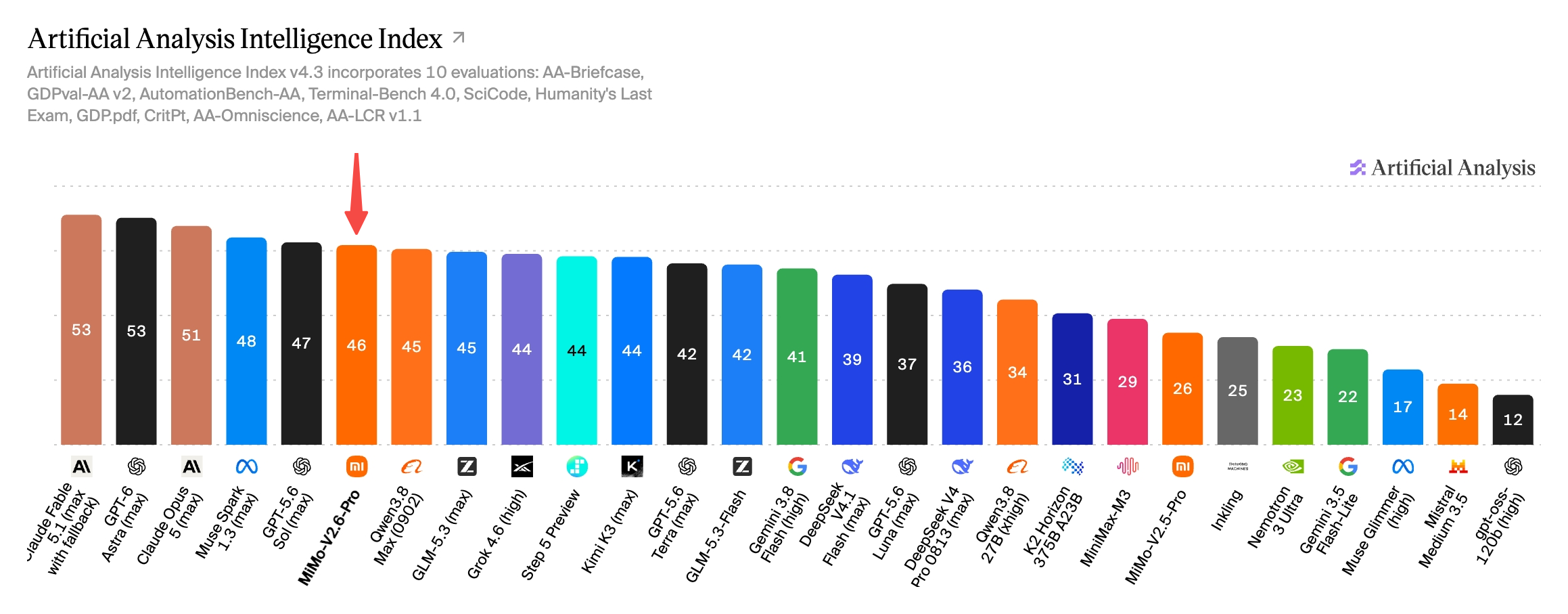
An independent Artificial Analysis measurement reports 46.32 for Pro on its Intelligence Index. That composite index has its own methodology and is not equivalent to Xiaomi's internal tests. Artificial Analysis also measures roughly 124.5 output tokens per second on the Xiaomi API and an approximately $0.18 blended price per million tokens under its default 7:2:1 cache, input, and output mix.[Artificial Analysis provider measurement] Because the independent V2.6 Flash page does not yet provide the same complete index coverage, a single external ranking should not be used to declare a direct Pro versus Flash winner.
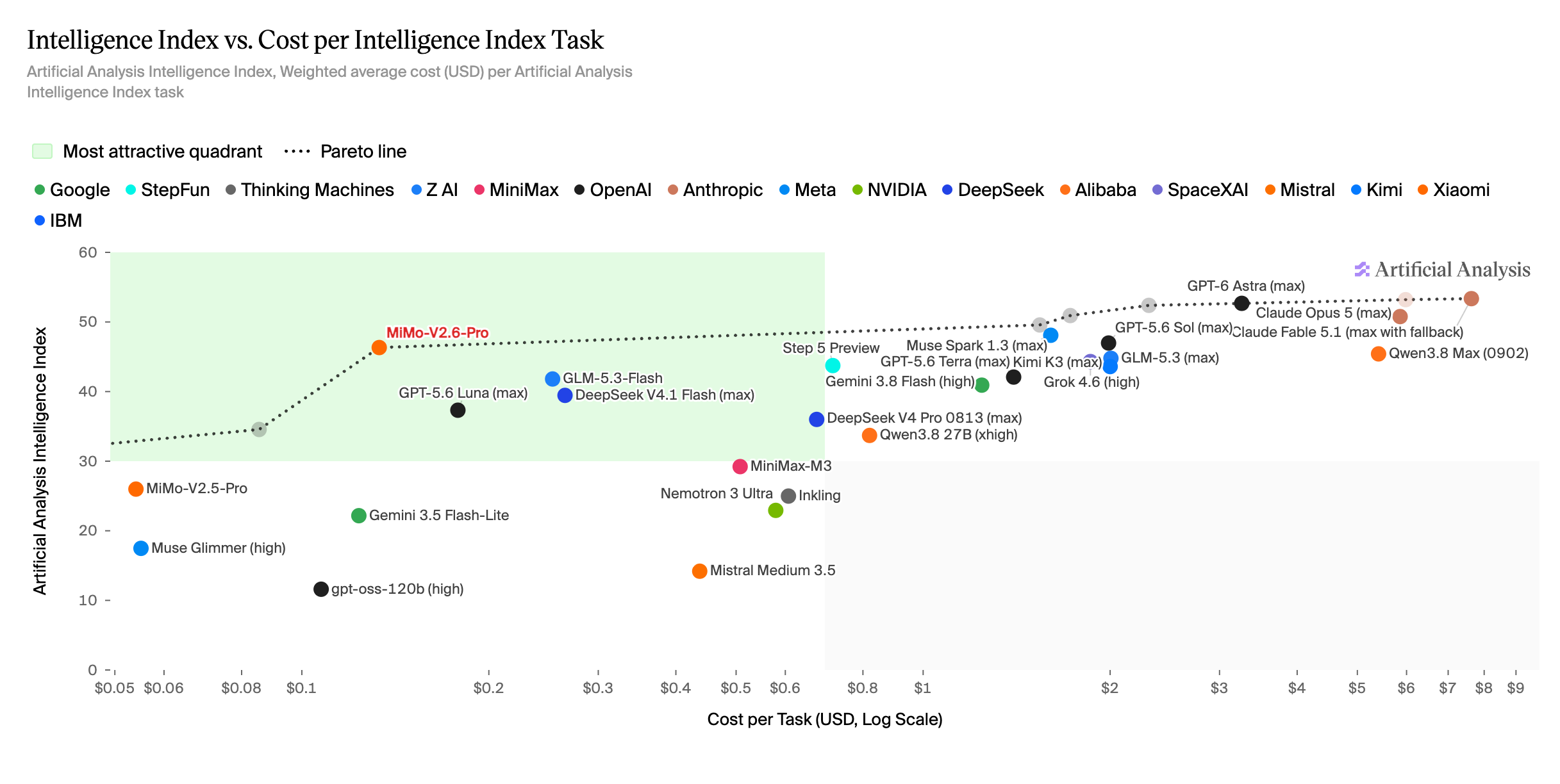
Source: Xiaomi's V2.6 announcement and Artificial Analysis data.
Pricing: do the token math yourself
Xiaomi lists its overseas real-time API prices per million tokens. A cache hit means previously processed prefix content is billed at a much lower rate. Cache writes are free for a limited time according to the announcement. Web search is billed separately per call and is not included in the token price.[Official pricing documentation]
| Model | Input, cache hit | Input, cache miss | Output | Batch input, miss | Batch output |
|---|---|---|---|---|---|
| MiMo-V2.6-Flash | $0.0028 | $0.14 | $0.28 | $0.07 | $0.14 |
| MiMo-V2.6-Pro | $0.0036 | $0.435 | $0.87 | $0.2175 | $0.435 |
| Pro UltraSpeed | $0.036 | $4.35 | $8.70 | Not supported | Not supported |
Consider a task with 500,000 fresh input tokens and 100,000 output tokens. Flash costs 0.5 × 0.14 + 0.1 × 0.28 = $0.098. The same task costs 0.5 × 0.435 + 0.1 × 0.87 = $0.3045 on Pro. If Batch API is available, the figures fall to approximately $0.049 and $0.15225. Pro costs about 3.1 times more in this example, but fewer retries and less human intervention on difficult tasks can change the total project economics.
A cache-heavy agent loop looks different. For 400,000 cache-hit tokens, 100,000 fresh input tokens, and 100,000 output tokens, the Flash bill is $0.04312 and the Pro bill is $0.13194. Caching system prompts, tool definitions, and stable project context therefore matters. An integration that resends the same long context on every turn can create an unnecessary bill even with the cheaper model.
The OpenRouter Pro page and Flash page show the same list prices, roughly 1 million token context, and Xiaomi as the provider. In the first-day measurements, OpenRouter showed a P50 of 79 tokens per second for Flash and 39 tokens per second for Pro. These are short-window, provider-specific values. Do not promise an SLA before testing with your region, prompt length, and tool pattern.
Which model fits which project?
- Choose Flash: Large numbers of short and medium coding fixes, support automation, document classification, regular tool calls, and product flows where cost matters as much as quality. Its 52.3 on AutomationBench and 80.8 on OSWorld-Verified provide a strong everyday agent baseline close to Pro.
- Choose Pro: Large repositories, difficult research, workflows combining visual and audio inputs, cybersecurity analysis, long planning chains, and tasks where recovery after failure matters more than the lowest token price.
- Use both: Run Flash for first attempts, routing, and routine steps. Escalate ambiguous, critical, or final-verification steps to Pro. This routing strategy should be evaluated alongside the total-cost model discussed in our local LLM deployment article.
The open-weight route is available through Hugging Face and ModelScope, but "open weights" does not mean a small GPU can run the model comfortably. The Pro model card places the checkpoint in the 524B file-size class, while the Flash card places it in the 159B class. SGLang deployment examples for Pro require multi-GPU and expert parallelism; Flash needs a smaller but still substantial GPU cluster. The API is the sensible first test for most teams. Do not choose self-hosting without adding hardware, power, operations, and quantization costs to the calculation.
Open source and production risks
Xiaomi says it released the weights, technical report, RL code, training environments, and more than 7,000 task environments with V2.6. That is significant for researchers. Instead of consuming the model only through an API, teams can inspect the reward design, training ideas, and agent harnesses.[Xiaomi MiMo on Hugging Face]
The results still need independent verification. Xiaomi's official tables include in-house evaluations. The technical report's appendix discusses a ground-truth commit deletion issue in SWE-Bench images and the risk of reward hacking. That level of disclosure is useful, but production teams should still record the evaluation version, tool permissions, test-set leakage risk, and the rules for counting a failed task.
Community sources support the same caution. BenchLM's comparison explicitly says there is not enough independent public data to rank Pro and Flash on a common quality lane. LLM Stats labels some Pro results as provider-reported and not independently verified. The soundest method is to build a small evaluation set from your own tasks and track cost, success, latency, retry count, and human intervention together.
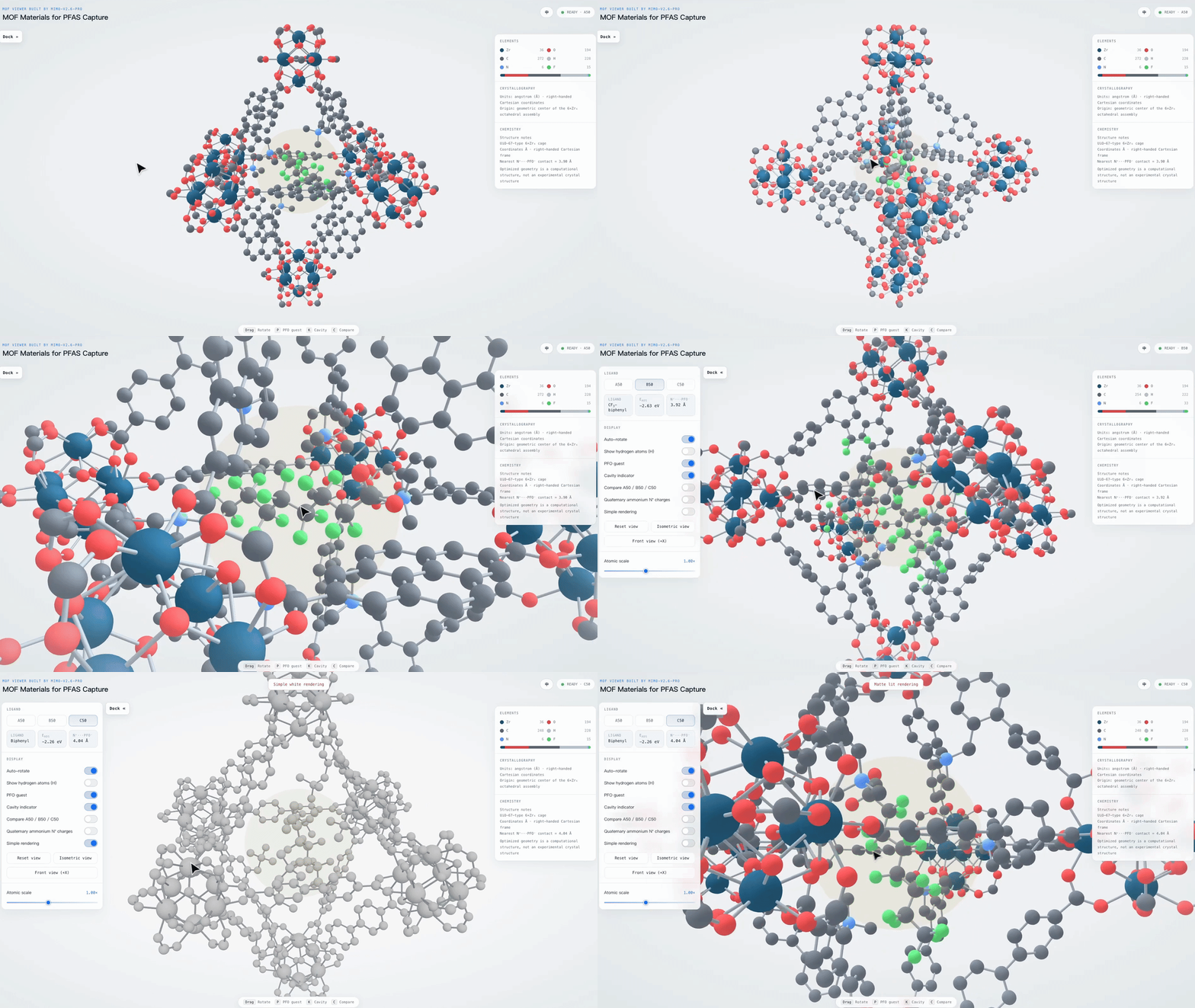
Source: MiMo-V2.6-Pro model page.
Conclusion: the right deployment mix matters more than a single winner
MiMo-V2.6 Pro and Flash push Xiaomi's open-weight strategy further. Pro combines a 46.32 Artificial Analysis Intelligence Index score, a 1 million token context, and strong agent benchmarks to narrow the gap with leading open models. Flash offers the same multimodal foundation and 1 million token context at a much lower token price, making it more attractive for high-volume workloads.
The benchmark table shows two facts at once. Pro is ahead of Flash overall but does not lead every test. Flash comes close with a smaller active compute budget and exceeds Pro on a cybersecurity benchmark. Model selection should therefore not be based on total parameter count. Measure your workflow, design for cache reuse, add a second verification pass to critical tasks, and calculate the real cost of retries.
A practical starting point is a small Flash production trial paired with a Pro quality-control run on the same tasks. Your own evaluation set will reveal which model saves more time and money. If you test MiMo-V2.6 for coding, research, or multi-agent workflows, share the results. The future of open models will be decided not only by leaderboard points, but by reproducible production outcomes.
Sources
- Xiaomi, Introducing the MiMo-V2.6 series
- Xiaomi MiMo Docs, Scaling Up Reinforcement Learning
- Hugging Face, MiMo-V2.6-Pro-RL model card
- Hugging Face, MiMo-V2.6-Flash-RL model card
- Xiaomi GitHub, MiMo-V2-Flash repository
- arXiv, MiMo-V2-Flash Technical Report
- Xiaomi MiMo API Pricing
- Xiaomi MiMo-V2.6-Pro model page
- Xiaomi MiMo-V2.6-Flash model page
- Artificial Analysis, Pro provider benchmarks
- OpenRouter, MiMo-V2.6-Pro
- OpenRouter, MiMo-V2.6-Flash
- n8n AI Benchmark, MiMo-V2-Flash
- TechNode, Xiaomi's live RL dashboard
- LLM Stats, MiMo-V2-Pro scorecard
- BenchLM, Flash versus Pro comparison
- PricePerToken, MiMo V2 Flash pricing
- Medium, technical review of MiMo-V2-Flash
- Hacker News discussion of the MiMo-V2.6 RL dashboard
- Xiaomi, Introducing MiMo-V2-Flash
Written by

Efe Özkan
AI & Software Developer